Stinging insect activity in Northeast Florida escalates rapidly between April and October due to persistent 80-degree temperatures and subtropical humidity along the St. Johns River basin. Southern yellow jackets…
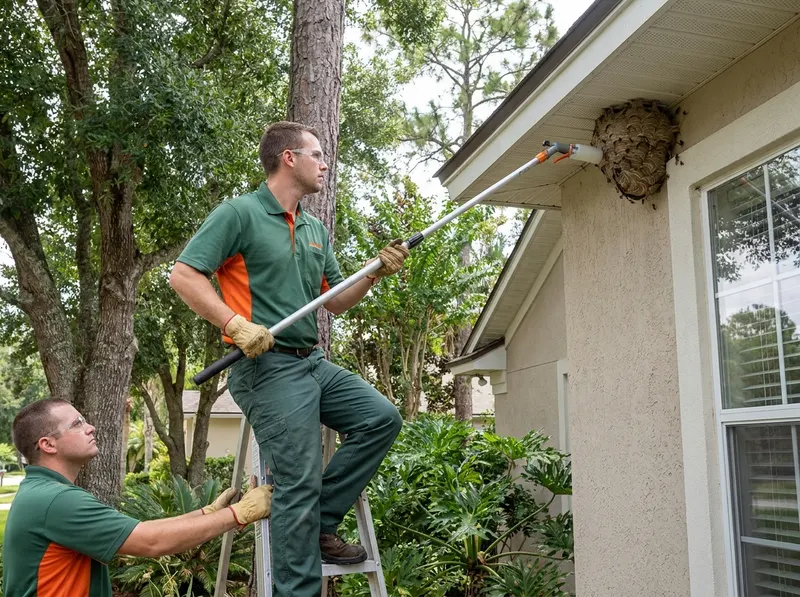
Stinging insect activity in Northeast Florida escalates rapidly between April and October due to persistent 80-degree temperatures and subtropical humidity along the St. Johns River basin. Southern yellow jackets routinely exploit sandy soil around roots in residential Mandarin and Southside, establishing subterranean nests containing upwards of 4,000 workers. Conversely, bald-faced hornets and aerial paper wasps anchor heavy paper nests beneath the multi-story eaves of historic estates in Riverside, Avondale, and San Marco, as well as behind architectural trim in Springfield. Mechanical store-bought sprays frequently fail against these colonies because standard aerosol jets trigger defensive alarm pheromones before penetrating the core brood comb, dispersing agitated insects toward family members and pets.
Surgical eradication requires matching the chemical formulation and delivery pressure to the nesting biology. Exposed paper wasp clusters on a ground-floor soffit allow direct aerosol knockdown and mechanical scraping. In contrast, subterranean yellow jacket nests or hornets concealed inside exterior brick weep holes require directional micro-encapsulated dusts injected under regulated pressure. The dust adheres to returning foragers, carrying the active toxicant deep into the queen's brood chamber without forcing aerosol blowback into living quarters. A standard single-story exterior removal fits open soffit installations, whereas multi-story ladders or structural void extractions involve specialized access equipment and safety rigging, reflecting the higher labor trade-off required to secure the perimeter.
Properties bordering dense foliage near the Timucuan Ecological and Historic Preserve, Fort Caroline National Memorial, and the riverfront bluffs of Ortega encounter elevated foraging pressure from aggressive social vespids. Once colonies are neutralized, physical nest material is extracted to prevent secondary infestations from carpet beetles and blowflies. The entry point is treated with long-lasting residual dusts to block re-colonization. Services do not require multi-month recurring contracts, and standard exterior applications do not mandate home evacuation, allowing domestic routines to continue safely while chemical barriers stabilize the exterior boundary.
Every job gets a firm, written price after a free on-site visit.
Tell us about your wasp, hornet, and yellow jacket removal job in Jacksonville and we'll send a clear, written quote, usually the same day.
 Moxelli Pest Specialists