Flea and tick yard eradication in Jacksonville addresses heavy ground-level infestations that interior surface sprays fail to control. In coastal Northeast Florida, maritime humidity and subtropical temperatures…
Flea and tick yard eradication in Jacksonville addresses heavy ground-level infestations that interior surface sprays fail to control. In coastal Northeast Florida, maritime humidity and subtropical temperatures sustain continuous flea and tick breeding cycles through ten months of the year. Shaded root systems beneath live oaks in Riverside, Ortega, and Avondale, along with damp pine straw beds across Mandarin and Southside, form primary host harborages. Left unaddressed, untreated perimeter soil functions as an active biological reservoir, enabling wild raccoons, feral cats, and neighborhood rodents to redeposit viable parasites along foundation perimeters and patio edges.
Targeted exterior eradication fits properties experiencing repeated pet reinfestation, localized outdoor tick activity, or visible flea swarms rising from turfgrass. This tactical methodology differs from standard perimeter maintenance. General quarterly pest control focuses on broad exclusion around structural walls, whereas parasite yard eradication saturates the specific vegetative zones, ground litter, and turf canopy where flea larvae develop and adult ticks quest for passing hosts. Treating the yard source prevents parasites from migrating indoors, eliminating the need to evacuate living spaces or saturate interior living areas with baseboard chemicals.
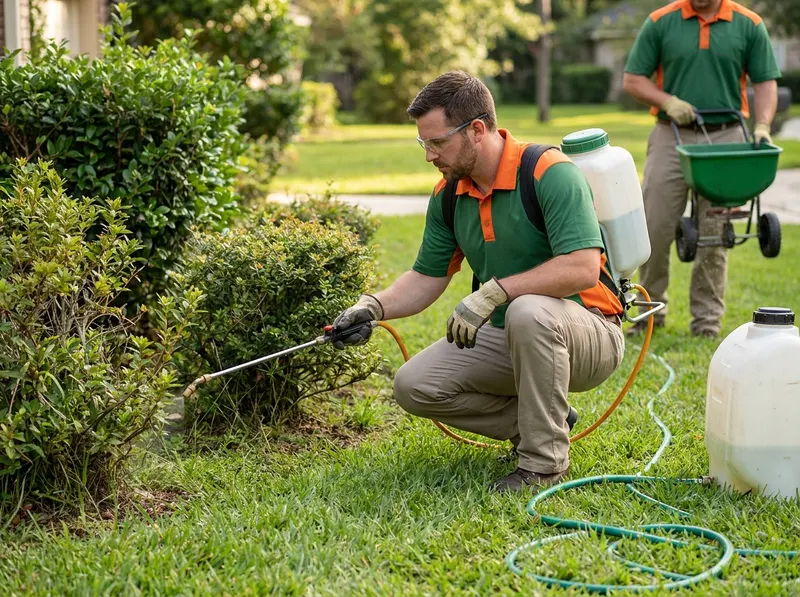
Executing this protocol involves a systematic sequence. First, a technician maps high-risk zones, inspecting fence lines, pet resting areas, low-hanging shrubbery, and property borders adjoining wooded tracts or drainage basins near the St. Johns River and Fort Caroline. Second, high-volume hydraulic equipment disperses microencapsulated liquid treatments across turf and shaded fence lines. Third, water-activated granular materials are applied deep into thick ground-cover like jasmine or mulch beds. Fourth, an insect growth regulator (IGR) is integrated into the formula to arrest chitin development, permanently preventing immature flea larvae from maturing into breeding adults. Once treatments fully dry, generally within 60 to 90 minutes under Florida sun, treated lawns remain safe for domestic pets and family activities without chemical tracking.
Every job gets a firm, written price after a free on-site visit.
Tell us about your flea and tick yard eradication job in Jacksonville and we'll send a clear, written quote, usually the same day.
 Moxelli Pest Specialists