Northeast Florida's subtropical climate forces roof rats into elevated home envelopes along the St. Johns River corridor. Historic wood-frame architecture throughout Riverside, Avondale, and Springfield features…
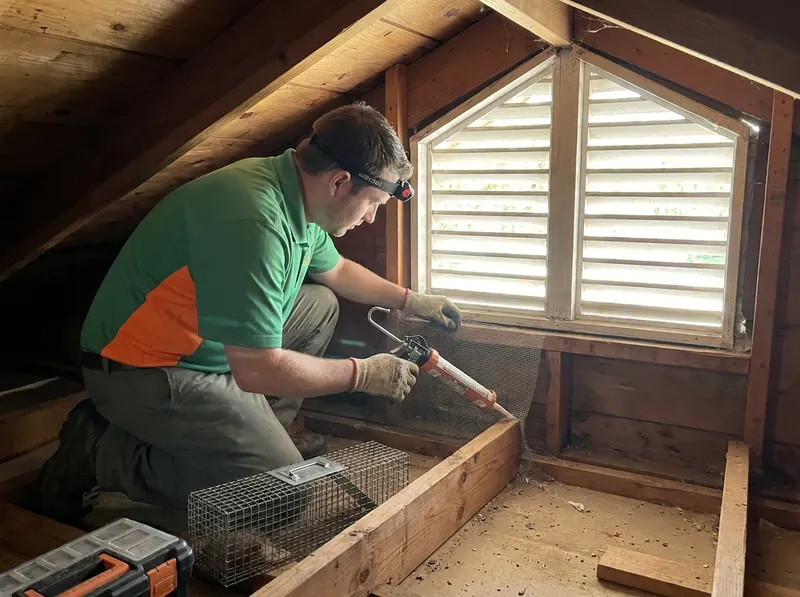
Northeast Florida's subtropical climate forces roof rats into elevated home envelopes along the St. Johns River corridor. Historic wood-frame architecture throughout Riverside, Avondale, and Springfield features exposed rafter tails, open soffit pockets, and continuous ridge lines that grant rodents easy attic access. In newer slab construction across Southside and Oceanway, plumbing stacks, roof valleys, and builder gap voids at the fascia-decking junction function as direct transit corridors. Rodents compress loose-fill insulation, gnaw electrical wiring, and introduce parasites into drywall bays. Over-the-counter rodenticides placed indoors create secondary toxicity hazards for domestic pets and result in animal carcasses decaying inside enclosed wall voids. Mechanical trapping paired with rigid exclusion stops this cycle at the building boundary.
Surgical exclusion differs fundamentally from generic quarterly extermination. Standard interior baseboard spraying leaves the primary roofline breach untouched. Effective rodent remediation requires installing 24-gauge, 1/4-inch galvanized hardware cloth behind gutter boards, fastening stainless steel chimney caps, and packing copper mesh around AC copper line sets. If high rodent populations already inhabit the attic envelope, mechanical traps inside the insulation perimeter run continuously for 7 to 14 days before entry points are sealed. Attempting exclusion prior to localized eradication drives trapped rodents downward into living quarters through ceiling penetrations. Conversely, trapping without structural sealing guarantees rapid re-infestation within weeks as outdoor pheromone trails persist.
Properties bordering mature oak canopies in Mandarin, Ortega, and Arlington face elevated pressure where overhanging limbs drop within 4 feet of shingles. Heavy canopy lines give roof rats direct bridges past ground-level defenses. The architectural trade-off involves prioritizing perimeter metal barriers over recurring chemical poisons: metal exclusion establishes a permanent physical boundary against gnawing incisors, whereas continuous poison bait stations merely mask ongoing structural vulnerability. Exact project costs adjust based on eave linear footage, roof pitch difficulty, and total entry voids confirmed during the initial structural assessment.
Every job gets a firm, written price after a free on-site visit.
Tell us about your attic rodent exclusion and trapping job in Jacksonville and we'll send a clear, written quote, usually the same day.
 Moxelli Pest Specialists