Duval County's year-round humidity and mild winter temperatures accelerate the reproductive cycles of bed bugs, allowing an untreated harborage to expand exponentially within multi-unit housing and detached residences.…
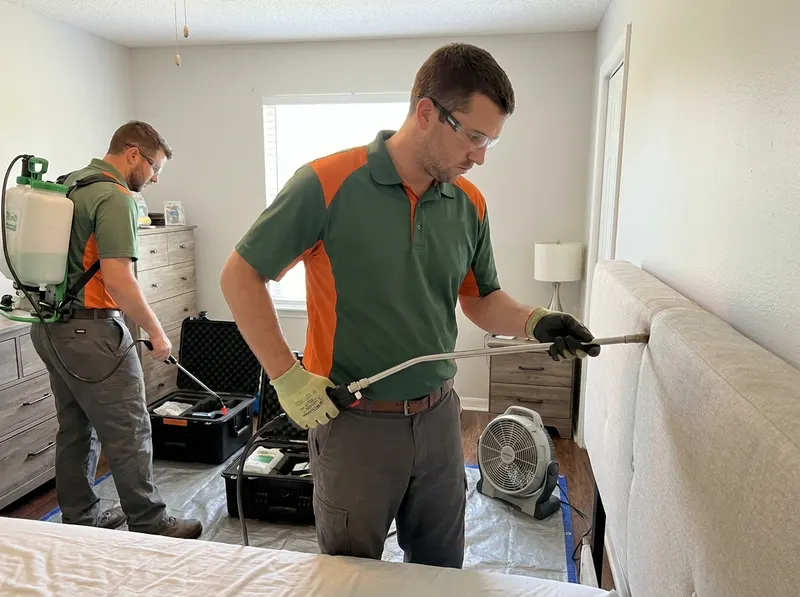
Duval County's year-round humidity and mild winter temperatures accelerate the reproductive cycles of bed bugs, allowing an untreated harborage to expand exponentially within multi-unit housing and detached residences. In historic riverfront properties across Riverside, Avondale, and San Marco, lathe-and-plaster architecture and settled baseboards create deep structural cavities where surface sprays fail to reach bed bug populations. Conversely, in slab-on-grade single-family homes throughout Southside, Mandarin, and Arlington, infestations often settle rapidly inside bed frames, behind electrical faceplates, and along carpet tack strips near the concrete floor joint.
Selecting between thermal remediation and dual-stage chemical remediation depends on structural occupancy and material composition. High-temperature convective heating elevates the entire ambient air and structural contents above 122°F, the verified thermal death point for bed bug eggs, within 90 minutes, maintaining that thermal threshold for several hours to achieve same-day eradication without requiring the complete removal of clothing. The trade-off is equipment footprint: industrial power generation and heating ducts require dedicated staging on driveways. For structures where sensitive electronics, medical gear, or localized containment prevent high heat, multi-stage residual chemical remediation provides a targeted alternative using insect growth regulators and desiccants; this approach requires 2 to 3 targeted visits spaced across a 21-day timeline to break the developmental egg cycle.
Preparatory procedures directly govern procedural success. Homeowners in Oceanway and Ortega clear loose perimeter clutter, wash bedding on high heat (reaching at least 130°F), and vacate the premises during application intervals. Pets and heat-sensitive items, including wax candles, pressurized canisters, and thermal-reactive vinyl blinds, must be isolated or removed prior to equipment activation. Inspection protocols use thermal imaging and visual harborage analysis to map colony boundaries before application begins, eliminating unnecessary structural disruption.
Every job gets a firm, written price after a free on-site visit.
Tell us about your bed bug thermal and chemical remediation job in Jacksonville and we'll send a clear, written quote, usually the same day.
 Moxelli Pest Specialists