Drywood termites bypass soil contact entirely, landing directly on roof decking, fascia, and soffits along coastal corridors and river basins. In historic Jacksonville districts such as Riverside, Avondale, and…
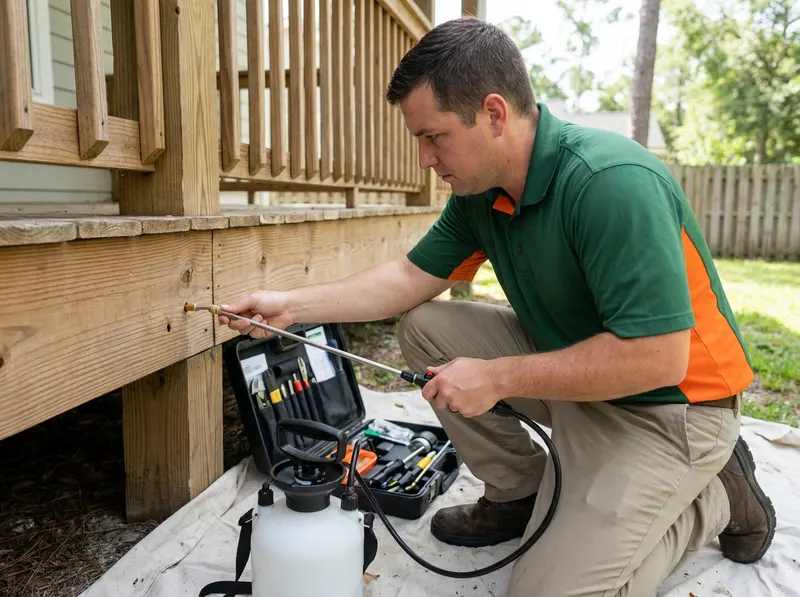
Drywood termites bypass soil contact entirely, landing directly on roof decking, fascia, and soffits along coastal corridors and river basins. In historic Jacksonville districts such as Riverside, Avondale, and Springfield, older heart pine structures frequently suffer targeted colonization in attic rafters and window framing. Unlike subterranean termites that require continuous ground moisture, drywood termites harvest ambient humidity from the St. Johns River basin, thriving inside enclosed joists. Localized gallery injection stops this movement by drilling small 1/8-inch ports directly into the carton channels and applying non-repellent termiticides under controlled pressure. Topical borate applications then penetrate raw dimensional lumber down to the structural core, creating an impassable barrier that prevents new swarmers from establishing nests.
A spot injection with borate surface treatment serves as a precise alternative when colony activity is isolated to specific timber spans or exposed attic sections. When an infestation remains confined to an exterior door frame in San Marco or roof trim in Ortega, spot applications resolve the active pocket immediately without forcing occupants to evacuate the property, dispose of refrigerated groceries, or dismantle exterior landscaping. The limitation occurs when termite galleries run inside inaccessible multi-story wall cavities or under tongue-and-groove flooring where chemical diffusion cannot reach timber members; in those scenarios, structural tent fumigation becomes the necessary intervention.
Duval County properties encounter swarm events from April through July, when reproductive alates emerge around exterior porch lighting and enter soffit vents. In slab-on-grade homes across Mandarin, Southside, Arlington, and Oceanway, drywood termite spot treatments protect structural truss systems and subflooring from progressive equity loss. Borate-treated wood remains protected permanently as long as the framing stays sheltered from active rainfall and exterior water leaks. Property owners can initiate an inspection by calling (904) 920-3004 to identify active wood-destroying organism galleries.
Every job gets a firm, written price after a free on-site visit.
Tell us about your drywood termite spot and borate treatment job in Jacksonville and we'll send a clear, written quote, usually the same day.
 Moxelli Pest Specialists